Diffuse Value Capture
· 23 min read
Published May 19th, 2025. Second edition April 19th, 2026.
1 Diffuse & Direct Value Capture
Alice and Bob both work 30 hours per week creating a similar digital good. They aim to capture value in various forms, such as money and social capital.
| Alice | Bob | |
|---|---|---|
| Hours worked | 30 | 30 |
| Value created | 10 | 100 |
| Capture rate | 90% | 10% |
| Value captured | 9 | 10 |
Alice captures 90% of the value she creates; Bob captures only 10%. Yet Bob ends the week with one more unit of value than Alice, for the same hours of work.
Alice is running direct value capture: many-to-one, closed, permissioned. Bob is running diffuse value capture: many-to-many, open, permissionless. The two exist on a spectrum, and extremes on either end are rarely workable.
The upside on the diffuse end has no ceiling. Produce 1,000 units and capture 1%, or 1,000,000 and capture 0.001%, and the absolute returns can still dwarf what direct capture allows.
2 Authorship & Originality
“Print created national uniformity and government centralism, but also individualism and opposition to government as such.”
—Marshall McLuhan, The Gutenberg Galaxy, 1962.
Authorship and originality are downstream of the dominant medium of reproduction. McLuhan’s point—that the printing press created the modern individual as much as it created the modern book—runs in reverse, too. When copying is cheap and decentralized, the bounded originating author becomes harder to defend.
For most of human history, cultural production was diffuse: stories built on stories, songs on songs. Before the printing press, works often circulated anonymously or under famous names borrowed for prestige; scribes copied freely because duplication itself was the bottleneck. The press collapsed that bottleneck and Western culture moved increasingly direct, culminating in the 20th-century broadcast era of Hollywood, television, music, and publishing. At the peak of that direct wave, the personal computer arrived and began swinging the pendulum back—not to a pre-industrial model, but to one made possible by decentralized global networks.
Cultural adaptation lags technological change. More than two centuries passed between the European printing press and the Statute of Anne, the first law to recognize authors—rather than printers—as rights-holders. The cycle has accelerated since, but the lag persists.
| Year | Tech/Event | Immediate Reaction | Lasting Legal Shift |
|---|---|---|---|
| 1040 | Bi Sheng (畢昇) invents movable-type printing in China | Modest adoption—woodblock printing remained more economical for a script of thousands of characters | Limited impact on Chinese legal frameworks for copying |
| 1450 | Gutenberg’s movable-type printing press | Explosion of vernacular Bibles, pamphlets; authorities panic over heresy. | None yet, copying suddenly cheap, rules nonexistent. |
| 1476 | Caxton sets up England’s first press | Crown issues ad-hoc printing patents, but enforcement is patchy. | Still no copyright—control via favors & guilds. |
| 1517 | Martin Luther’s Ninety-five Theses | Printed and distributed across Europe, sparks Reformation. | Demonstrates power of print to bypass traditional gatekeepers. |
| 1557 | Royal Charter for the Stationers’ Company | Guild monopoly lets Crown censor by licensing printers. | Corporate control substitutes for author rights. |
| 1662 | Licensing of the Press Act | Censorship tightens; printers need a license or face seizure. | Parliament grows wary of monopoly but has no alternative. |
| 1695 | Licensing of the Press Act Lapses | 15-year vacuum—anyone may print; pamphlet culture booms. | Chaos forces lawmakers in Parliament to rethink “who owns a text”? |
| 1710 | Statute of Anne | For the first time, authors, not printers, receive a 14-year exclusive right. | The birth of modern copyright—arrives more than 260 years after the printing press. |
| 1910 | Qing Copyright Code | Short-lived in its Qing form but modeled on European statutes | Carried forward by Republic-era acts (1915, 1928) |
| 1990 | PRC Copyright Law | Enacted September 1990, effective June 1991 | Modern copyright arrives in China—nearly three centuries after the Statute of Anne |
If the printing press took more than two centuries to produce modern copyright, the internet has had three decades. We are only at the dawn.
3 Neo-China Arrives from the Future
“The seal stamps on old Chinese paintings are fundamentally different from the signatures used in European paintings. Primarily they do not express authorship that might have authenticated the picture, thereby making it unassailable. Instead, most seal stamps come from connoisseurs or collectors who inscribe themselves into the picture not only through their seal but also through their commentaries. Here art is a communicative, interactive practice that constantly changes even the artwork’s appearance. Subsequent viewers of the picture take part in its creation.”
—Byung-Chul Han, Shanzhai 山寨, 2017.
What Han describes is not a stylistic preference but a different theory of art—one in which the work is finished by everyone who later touches it. China has a long literati tradition of individual authorship and signed work, but it also has a Daoist and Confucian strand that treats originality less as a singular act of creation than as an ongoing natural process. Skillful reference signals depth of knowledge, and originality lies more in subtle recombination than in radical novelty.

In late November 2023, DeepSeek-AI open-sourced its DeepSeek LLM 7B and 67B models, which outperformed Meta’s Llama 2 70B on HumanEval, GSM8K, and MATH. Fourteen months later, on January 20, 2025, it unveiled DeepSeek-R1, a reinforcement-learning fine-tune of DeepSeek-V3—a 671B-parameter Mixture-of-Experts model with about 37B active parameters per token—that matched OpenAI’s o1 on reasoning benchmarks like AIME 2024 and MATH-500. DeepSeek reported that V3’s final pretraining run cost roughly $5.6M in GPU-hours, a figure that excludes R1’s subsequent RL stage and all prior research. The full 671B model still requires server-class hardware to run, but the distilled R1 variants—32B and 70B—fit on one or two consumer GPUs at common quantizations.
Western incumbents still cling to a more direct value capture mindset—API call metering, closed weights, NDAs—while Chinese labs treat the model itself as advertising for downstream services, hardware, and prestige. A thin proprietary layer is all that’s needed for coordination, and even that doubles as trading alpha for their AI quant funds.
Western critics often portray China’s loose stance on intellectual property as a drag on innovation. In an AI-driven century, it may prove prescient. The Daoist-Confucian strand—rooted in naturalistic processes and continual transformation—may end up more closely resembling the IP norms of the 21st century than the romantic Western model: less a God-like act of creation from a single source, more like evolution itself.
The “Chinese century” might not be defined solely by GDP or rare-earth supply chains. It could be shaped by open-source abundance against closed-source scarcity.
Beijing’s two-stage roadmap calls for “basically realizing socialist modernization” by 2035 and building a “great modern socialist country” by 2049, the centennial of the PRC’s founding. Given the country’s cultural orientation toward authorship and the success of DeepSeek, the likely shape of that future is open-source abundance, not the closed bureaucracies that defined 20th-century socialism. Marx’s “general intellect”—the idea that collective knowledge embedded in machines and networks can eclipse individual labor as the chief driver of growth—is closer to a description of an AI-era open-source commons than of any state plan.
Most failures of post-Marx socialist experiments came from trying to solve problems created by overly direct value capture with more of the same: replacing markets with bureaucracy and coercion. But neither end of the spectrum requires a totalitarian apparatus to enforce it. Capitalism has no allegiance to closed proprietary systems, as evidenced by the rise of open-source software and the success of cryptocurrencies. When value increasingly lives in shared pools of code and models, exclusive IP and closed weights become friction; openness strengthens the network.
4 Neural Networks are Diffuse
Neural networks are diffuse by nature, and more direct value capture does not map well onto them.
Art, music, code, design, and other cultural artifacts—culled from the open web—are diffused across latent space. Once creativity is encoded as a multi-trillion-parameter fog, the notion that you can meter each droplet of inspiration the way you once metered a DVD sale becomes economically and technically incoherent.
A neural network does not store information like a database storing rows. Any given weight is meaningless in isolation; value emerges only from the statistical interaction of all weights acting in concert. Like pigments blended into paint, the original sources are no longer separable—you can’t point to a specific coordinate and say, “this vector belongs to that copyright holder.”
Listen to current conversations around AI and intellectual property and you’ll find little consensus on how to preserve the existing IP framework in this new era. Proposals for radical reform—once confined to the lunatic fringe—are now gaining traction in mainstream tech circles.
The increasingly diffuse nature of cultural production—and the growing openness to new ways of thinking about intellectual property—is a direct consequence of three converging trends:
-
The rise of decentralized networks over traditional media and finance.
-
Massively accelerated AI-driven content creation, built on a remix paradigm and inherently diffuse models.
-
Hyperfinancialization—the spread of crypto, tokenized incentives, TikTok-like creator payments, prediction markets, etc., into everyday activity—which blurs the line between leisure and labor.
This shift isn’t driven by political will or personal preference. Stewart Brand captured the tension: “Information wants to be free. Information also wants to be expensive… That tension will not go away.” The tension doesn’t go away—but market competition keeps resolving it in one direction. In a free market, prices fall toward the marginal cost of production, and for information that cost is near zero. Competition eventually breaches every barrier built to hold prices above that floor, and the ground rarely comes back. The motion is a ratchet. This is why I see potential in diffuse value capture business models, where startups can compete with big incumbents by working with the grain of the software medium and strategically building thin capture layers into ecosystems that leak more value than many traditional US tech companies are comfortable with.
5 The Hacker Ethic
The precepts of this revolutionary Hacker Ethic were not so much debated and discussed as silently agreed upon. No manifestos were issued. No missionaries tried to gather converts. The computer did the converting.
—Steven Levy, Hackers, 1984.
Computers speak in copies, and the cost of duplication is effectively zero. When the medium itself is infinite replication, economic models based on overly direct value capture become increasingly difficult to maintain—the technology pulls toward abundance and sharing.
The architecture of computing encodes this “hacker ethic” at its core, much like neural networks are diffuse by nature. McLuhan’s larger point: a medium’s form has second- and third-order effects on culture, far beyond its obvious uses. A medium of costless copying reshapes norms around authorship, labor, and property whether anyone wills it or not.
Artificial scarcity imposed by legal means in the digital realm is an awkward simulacrum of real-world scarcity. Forcing physical-world notions of property onto information systems creates endless friction and runs counter to the grain of the medium. This primal, often unspoken orientation at the heart of computing is what Richard Stallman later formalized as software freedom.
“We have already greatly reduced the amount of work that the whole society must do for its actual productivity, but only a little of this has translated itself into leisure for workers because much nonproductive activity is required to accompany productive activity. The main causes of this are bureaucracy and isometric struggles against competition. Free software will greatly reduce these drains in the area of software production. We must do this, in order for technical gains in productivity to translate into less work for us.”
—Richard Stallman, The GNU Manifesto, 1985.
Free software—and its defanged offshoot, open source—has been at the core of computing culture ever since. As a result, programming culture has adapted to the shift toward diffuse value capture more readily than most other industries. In contrast, neighboring professions have struggled to move beyond the 20th-century mindset of more direct value capture, along with its emphasis on authorship and originality.
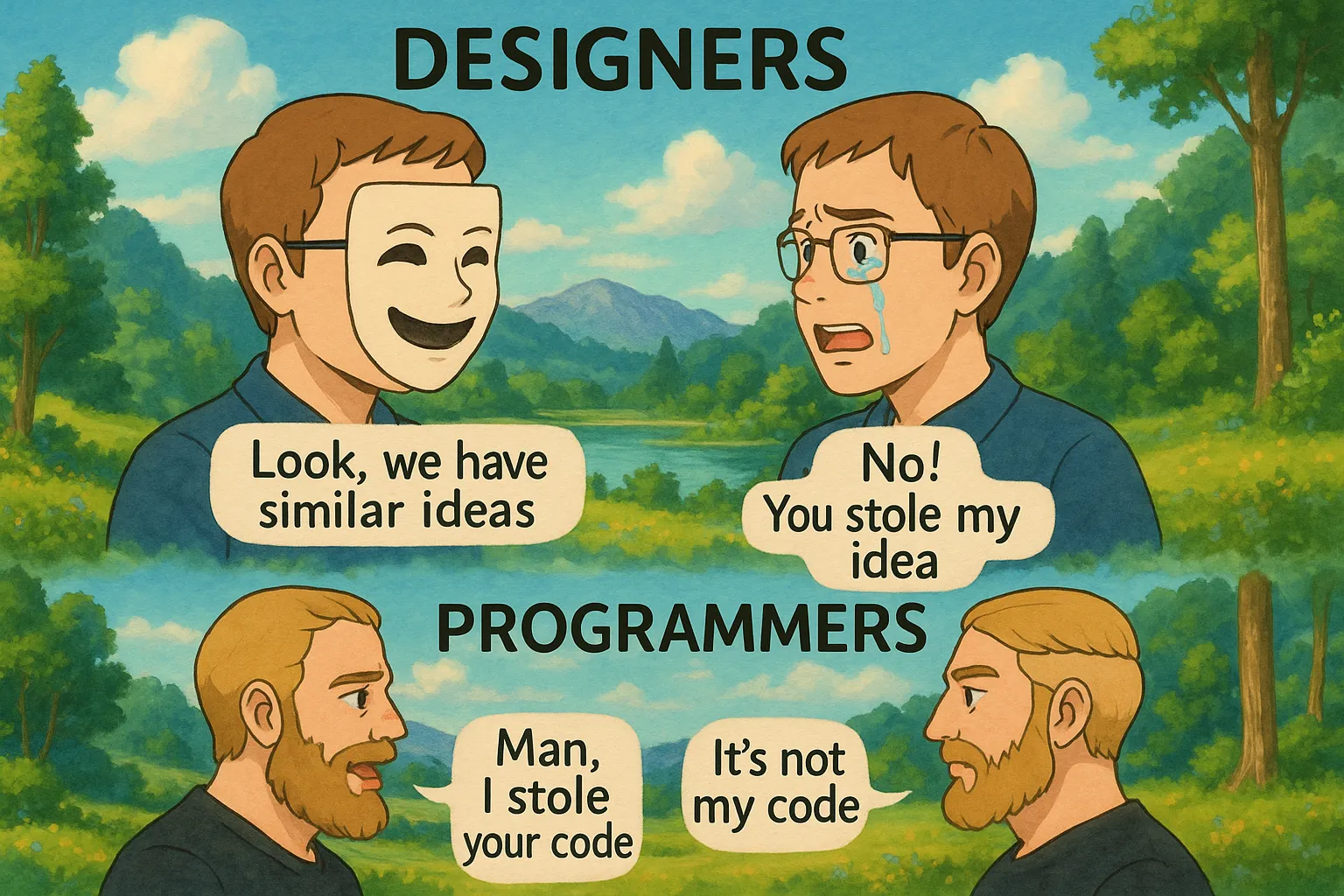
Despite its massive success, free and open-source software culture still struggles to develop effective systems for value capture and coordination. In many domains, it remains a niche—often relegated to controlled opposition, hobby projects, unpaid or underpaid labor, resume padding, or pawns in commoditize-your-complement strategies. The ecosystem continues to grapple with how to natively and diffusely capture value and coordinate production on its own terms.
Corporate patronage has been a primary driver of open-source development, but the more direct capture systems big tech uses often run counter to the diffuse nature of open-source. Bureaucracy, middle managers, and KPI-gaming pull developers toward metrics they can game rather than value they can create, while the same structures quietly incentivize gatekeeping knowledge to preserve personal advantage. The result is friction against the open, collaborative ethos that makes the ecosystem work.
More diffuse strategies align incentives with openness and ecosystem growth: the more you share and the more you help the project around you grow, the more value you ultimately capture. Some gatekeeping still protects community culture, but the information asymmetry and cronyism that more direct systems produce are less financially rewarded. The hacker ethic becomes aligned with financial incentives and competition at the highest levels of the market—where previously it stood in tension with more direct capture.
Partly open-source efforts like Google Fonts tend to ride inside larger proprietary companies. Further toward the diffuse end, no organization has yet matched Apple or Nvidia on coordination or capital formation. Crypto is the exception. Oriented toward the diffuse end from day one, it has produced market-scale value on its own terms—at one point in 2025, Bitcoin’s market cap briefly surpassed Google’s. A decentralized protocol with an anonymous founder had outpaced the company whose “Attention Is All You Need” paper ignited the current AI cycle. What’s going on here?
6 Crypto & Diffuse Value Capture
Satoshi started a fire in cyberspace. While the fearful run from it and fools dance around it, the faithful feed the flame, and dream of a world bathed in the warm glow of cyberlight.
—Michael Saylor
Technology should be deflationary: every efficiency and automation ought to push prices down in competitive markets. Yet goods and services feel more expensive every year. The US broad money supply (M2) grew roughly 40% between 2020 and 2025, masking the price reductions technology and automation would otherwise deliver. A fixed-supply asset like Bitcoin offers a bureaucracy-free way to capture value from technological progress.
The traditional equity market has its own gatekeeping problem. The best early-stage opportunities—private equity, venture capital, and pre-IPO startups—are inaccessible to most people. To participate you must be an accredited investor, meet income or net worth thresholds, and afford high minimum tickets. The public market often serves as a way for private equity to sell to retail after the returns have already been captured by insiders.
Today the average American cannot invest in leading AI companies like OpenAI or Anthropic. Retail investors seeking AI exposure are pushed into proxies like NVIDIA—but NVIDIA is a bet on its proprietary, more direct value capture strategy, not on AI itself, which has the potential to disrupt stable value capture moats like NVIDIA’s own. Lottery tickets and casino gambling are permitted; early-stage startup equity is not, supposedly for the public’s own good. The traditional financial system is too closed, proprietary, and gatekept to enable more diffuse value capture at the scale AI demands.
Global capitalism now requires open, fair, permissionless, and 24/7 financial infrastructure.
After Bitcoin’s success, many new blockchains emerged featuring smart contracts and decentralized applications—with the potential to replace the traditional financial system the way open-source software replaced proprietary software on the server side in the 1990s. These systems are open and diffuse by design—like computers and neural networks before them. The diffuse-to-direct orientation of the upstream infrastructure has downstream effects on how the technology gets used, which makes programmable blockchains like Ethereum conducive to more diffuse value capture.
If Bitcoin is digital gold, Ethereum functions more like a public world computer. Anyone can deploy a programmable token (an ERC-20 smart contract) that is immediately tradable on permissionless exchanges. Holders can pool two tokens in an automated market-maker like Uniswap, set or accept a swap fee, and earn a share for supplying liquidity—no bank or broker in the loop. The yield banks normally pocket on deposits flows straight back to participants.
While finance is Ethereum’s most developed use case, its potential extends further. As a general-purpose platform, Ethereum is also fertile ground for cultural experimentation. One of the highest-market-cap tokens on Ethereum isn’t tied to finance at all but to internet culture: 0x6982508145454ce325ddbe47a25d4ec3d2311933, $PEPE.
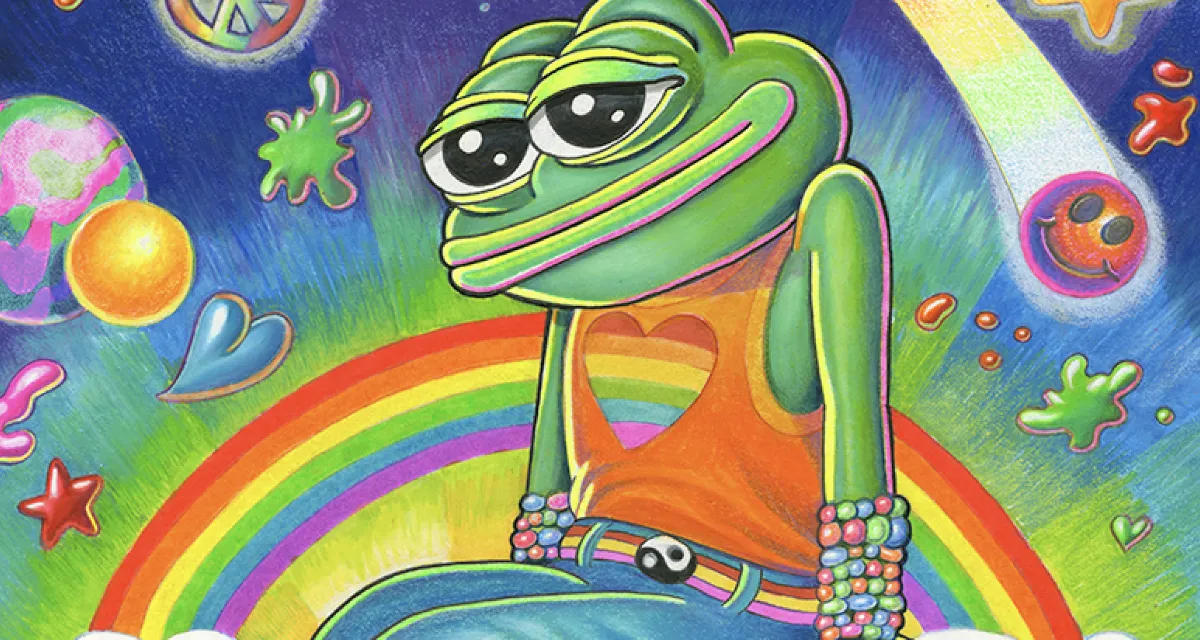
Pepe the Frog is a textbook example of the shift from direct to diffuse culture. Matt Furie created the character in 2005 as part of his comic Boy’s Club—originally a classic direct-culture setup, a single creator with full copyright control over the character and its world.
Furie’s own art style is a psychedelic blend of 1980s Gen X media: Jim Henson’s Muppets, Ronald McDonald, Skeletor, Freddy Krueger, the Ninja Turtles, Falkor from The NeverEnding Story—distorted through his own surreal lens. He doesn’t try very hard to disguise his influences. Furie represents an interesting checkpoint in the transition from direct to diffuse culture.
This highlights a core tension in more direct value capture systems: at some level, everything is a remix. Yet more direct value capture requires a certain level of abstraction away from source material to meet legal and social requirements for originality—asserting authorship over what is, in practice, always partially derived.
Pepe became an internet meme as the character spread across Myspace, 4chan, and Tumblr starting in 2008. By 2015 it was one of the most widely recognized memes on the internet, evolving in a decentralized, memetic fashion—without a central authority and entirely outside the intent of its original creator.
This eventually included Pepe’s adoption by extremist political groups, prompting Furie to try to use his copyright to stop the character’s use. There were some legal successes, but the character had completely escaped his control. Pepe took on drawing styles and lore with no single author, morphing into versions so different from the original that they took on other names and identities.
The internet made containment impossible. In an interview with Esquire, Furie said of Pepe’s use as a hate symbol: “It sucks, but I can’t control it more than anyone can control frogs on the internet.”
In late April 2023, during a crypto bear market following the collapse of FTX, a PEPE memecoin was launched on Ethereum. It reached a market cap of $1.6 billion by early May and peaked at $11 billion in late 2024, remaining in multi-billion-dollar territory.
The memecoin worked as a minimum-viable coordination and incentive mechanism layered on top of a diffuse cultural phenomenon. Anyone holding the token could create content for it without permission, and if the content got enough attention the token went up—a basic attention market, and an incentive structure for propagating the meme.
Crypto has a concept called “working for your bags.” Traditional wage labor spends a massive amount of time just trying to get the next job. In crypto, you can buy an asset you think is undervalued without permission and immediately go to work inside the open community around it—making memes and content on social media, or at a more serious level, buying a token for some open-source technology or protocol and contributing on GitHub while talking about it online.
This already happens with equities in coarse form: people who own a lot of Apple stock tend to own Apple products, and are incentivized to promote them and ignore their flaws. Crypto allows this to happen at much finer grain.
Blockchains have a lot of problems preventing mainstream adoption, but a likely future is that many open-source software projects will have associated tradable assets, creating real-time 24/7 market data for the global open-source ecosystem.
7 Post-Authorship
The obsession with authorship and originality that results from an over-reliance on more direct value capture has become a weight dragging down creativity, collaboration, and production incentives. The path to success becomes isolating, owning, controlling, and defending infinitely copyable intangible ideas—at odds with how culture and technology actually evolve, and actively suppressing the social and memetic nature of cultural production.
Design social media shows the pattern at work. Scroll long enough and you’ll see an endless parade of designers complaining that someone stole their work—recently over things as trivial and obviously un-ownable as color gradients. Meanwhile the quality of design in the everyday world degrades: the pressures of more direct value capture push designers toward performing as expressive auteurs rather than building durable visual systems. What our environment gets in return is expressive slop where functional, authorless late-modernism used to be.
Case in point, from late 2023: a widely-praised “Satie graphic” turned out on inspection to be little more than the font Ogg Regular with one character swapped to italic and a bit of tracking.
The Satie graphic is just the font Ogg Regular with the i changed to Ogg Regular Italic, plus a little bit of tracking…https://t.co/XtOXnRN6jE https://t.co/i59g2tbP5P
— Eli Heuer (@eliheuer) November 30, 2023
In August 2021, the NFT profile-picture project Milady launched on Ethereum, designed to be diffuse from the start. It was licensed under the VPL, a simple copyleft license that allows derivative works without permission but requires them to be released under the same terms. The project invited an ARG-like game where anyone could make and sell derivative NFT collections. The PFP became a kind of license to have fun online, freeing wearers from the stifling pressures of identity and authorship. The community encouraged stealing tweets and wearing NFTs you didn’t own. Where Pepe foreshadowed the loss of authorial control, Milady formalized it as a design principle.
One of the key people behind the project was Charlotte Fang, who wrote extensively about art criticism at the time. In 2022 he published “Unpacking Post-Authorship,” which formalized the idea as a way of thinking about art and design after blockchain and AI—an alternative to the increasingly stifling identity and authorship culture of legacy art and design institutions:
1. Remixing is the natural mode of artmaking online; introducing any friction to process materials damages the sum art output of the community,
2. Social mores of accreditation and permissioned remixing hinder a works ability to propagate (intact or remixed) reducing its memetic fitness; anonymizing work is often its liberation, and
3. Art comes from the beyond & not in isolation; as the artist serves only as handmaiden to higher consciousnesses, it’s hubris to be entitled to its bounties especially at the expense of its memetic fitness.
—Charlotte Fang, Unpacking Post-Authorship, 2022.
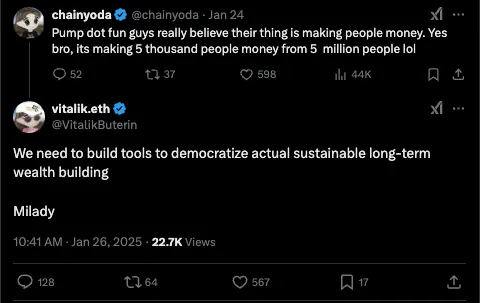
The Milady community made money and had fun online while the broader art and design world fought over scraps from legacy institutions. The all-time high floor price for Milady NFTs was 7.8 ETH ($20,000 USD at the time) around May 10–11, 2023, following a tweet by Elon Musk featuring a Milady. Unauthorized derivative works were made and sold by the thousands, many featuring AI-generated images. At one point Vitalik Buterin wore a Milady NFT as his Twitter/X profile picture.
The GPL was never intended as anti-commercial—Stallman explicitly designed it to enable business models built on free software. Companies could sell support, customization, hosting, or integration services while the code itself remained free. Red Hat proved this model could work, building a multi-billion-dollar business on open-source software.
But these traditional open-source business models still rely on somewhat more direct value capture—selling services to specific customers through conventional contracts. They’re missing what might be the final piece of the GPL/copyleft vision: a native, diffuse economic layer that aligns with the license’s viral, collaborative nature. Just as Linus Torvalds provided the missing kernel that made GNU tools a complete operating system, crypto markets—with base-level protocols and culture that are largely copyleft-oriented—might provide the missing economic infrastructure that makes copyleft a complete economic system.
Imagine if every GPL project had an associated token that appreciated with adoption and improvement. Contributors would be incentivized to enhance the commons rather than fork it for proprietary advantage. Users could invest in the tools they depend on. The same viral property that makes GPL code spread could make economic value flow back to creators—diffusely, automatically, without gatekeepers.
Many programmers and designers are financially incentivized to work in proprietary models on large projects they have little authorship over. Can permissionless open-source projects recreate those incentives natively?
8 Post-Authorship Peer Production
“There is no reason to believe that bureaucrats and politicians, no matter how well meaning, are better at solving problems than the people on the spot, who have the strongest incentive to get the solution right.”
—Elinor Ostrom
“Even a billion dollars of capital cannot compete with a project having a soul.”
—Vitalik Buterin
TikTok is a useful middle-of-the-spectrum example. ByteDance owns the platform and a proprietary algorithm decides which videos propagate, but the creation layer is diffuse: a format emerges, thousands of creators remix it, the best versions spread, the rest fade. The same coordination shape shows up in GitHub, Hugging Face, and Linux at different points further toward the diffuse end—many contributors, flatter hierarchies, and output that stays available for anyone to use, remix, and extend. Call it post-authorship peer production.
Post-authorship removes many of the barriers to collaboration that have held back peer production, especially in cultural areas like art and design. When contributors stop worrying about who owns what idea, energy shifts from defending territory to building together, unlocking long-tail innovation.
Once the first copy of a program, video, or AI model exists, duplicating it costs almost nothing. Competitive pressures, piracy, and open-source alternatives push prices toward the marginal cost of production, which for digital goods is near zero. In this environment, diffuse value capture often outperforms direct approaches like paywalls, DRM, and legally enforced artificial scarcity. Incentives aren’t abolished but rewired.
The printing press took more than two centuries to produce modern copyright. Blockchains and AI may need only decades to retire it. The rails for diffuse value capture are already in place; cultural norms just need time to catch up.
Colophon
This post is typeset in Bezy Grotesk, a free and open-source font designed by Eli Heuer, the essay’s author. It is built on the authorless memetic commons of the International Typographic Style and the work of many other designers, both known and unknown.